Monday, June 13, 2011

Your Temporal Extension


"I watched as her fingers drew a perfect line in space, I watched as she looked on through into another place." - Devo, "The 4th Dimension"

There's a quantum-physics notion that Time is either a key part of the Fourth Dimension or actually is the Fourth Dimension itself. With that view, some startling things about life, birth and death inevitably rear their head.

Viewed from the Fourth Dimension, some posit that you and I are actually worm-like entities that represent the "us" as we see ourselves from birth to death, like a series of Muybridge photographs showing a runner proceeding from A to B. Even though the runner was at point A and then moved on to point B, quantum theory says his actual self is at both those points simultaneously and both are expressions of the same entity.

As you sit there reading these words on your computer monitor, imagine that the "you" who was getting turkey slices out of the fridge half an hour ago is part of a greater entity that includes the "you" that sits here now. From a 4-D perspective, we are an entity that extends into our past and our future. We think that our future "hasn't happened yet" but this is an artifact of our limited consciousness, as is our perception of what we call Time.


J.H. Brennan describes it best:

"It is the focus of our consciousness that creates the sensation of time passing, rather as looking through the window of a train creates the sensation of scenery passing, although we know the world outside the train is in fact standing still."

Meanwhile, science has finally caught up with what philosophers knew all along - that everything we have experienced in our life is permanently recorded and nothing is ever truly forgotten - which also fits in perfectly with four-dimensional theory.

Looking into the future, now that's a little trickier. But it can be done. And philosophy, once again, has the leading edge over modern science with their zillion-dollar particle supercolliders.

Thursday, May 5, 2011

Common Sense


Thomas Paine is one of the best-known among the Founding Fathers of the USA even though he never held a political position. His main claims to fame are Common Sense, Rights of Man and Crisis, booklets that helped to incite colonists into overthrowing the British Government and starting a new civilization. I remember reading about this booklet in school, but we didn't actually read it. Had we done so, it would've been most illuminating, I think, to hear that the seeds of the American Revolution had proto-capitalistic motives even then:

"What have we to do with setting the world at defiance? Our plan is commerce, and that, well attended to, will secure us the peace and friendship of all Europe; because, it is the interest of all Europe to have America a FREE PORT."


There are a lot of aspects of Paine that didn't make it into my high school civics class, in fact. Our textbook by Daniel Boorstin didn't mention that after helping to found America, Paine high-tailed it to France, palled around with Napoleon, and advised the French government on methods to conquer America. Eventually he ended up pissing off the French as well, and found himself in a cell awaiting the gullotine. He very narrowly escaped being beheaded and got a reprieve.

He published a diatribe against Christianity and religion in general, called The Age of Reason. In so doing, he turned almost all of his former friends and allies against him. When he died in 1809, only six people attended his funeral.

His contradictions and excesses must be taken with the giant grain of salt necessitated when assessing any truly great man; he ping-ponged around the globe like a pirate philosopher, doing whatever he needed to do to survive, and for his ideas of free-thinking to survive. Somehow, in the midst of all his revolutionary activities, he found time to be editor of Pennsylvania Magazine, architect of bridges (one of which was unique enough that he received a patent on its design), developed a smokeless candle, and worked with John Fitch in inventing steam engines. What have you done lately?

Tuesday, May 3, 2011

The Nernst Lamp


The more I hear well-meaning but misguided souls blather about the "carbon footprint" of incandescent bulbs and how it will "obviously" help save the Earth if we switch to pet-killing toxic Mercury-filled CFL bulbs, the more I think it's time somebody went back into the Nernst Lamp business.

The Nernst Lamp, invented in 1897 by the German physicist Walther Nernst, was twice as efficient as carbon filament bulbs and emitted a superior natural-color light. Unlike tungsten-filament bulbs, it did not require a vacuum to function, which means anyone could make one in their garage if they knew how. The only reason they're enclosed in a bulb at all is to protect users from touching the workings.

They operated by way of a ceramic rod that is superheated until it glows, giving off a more effective light source than you might expect. The device has an elegant and ingenious built-in heating element, which gets the ceramic hot enough to begin conducting electricity on its own.

George Westinghouse saw the potential for Nernst's invention, obtained the U.S. rights to the patent, and set about manufacturing them himself, from his newly-formed Nernst Lamp Co. based in Philadelphia. To obtain sufficient quantities of the best Gadolinite to manufacture the ceramic rods, he ended up in a competition with his (and everyone's) evil arch-enemy Thomas Edison for a place in Texas called Barringer Hill. This was an amazing treasure trove of rich mineralogical specimens, which was tragically and stupidly flooded permanently when the construction of the Buchanan Dam in 1939 turned the area into what is now Lake Buchanan.

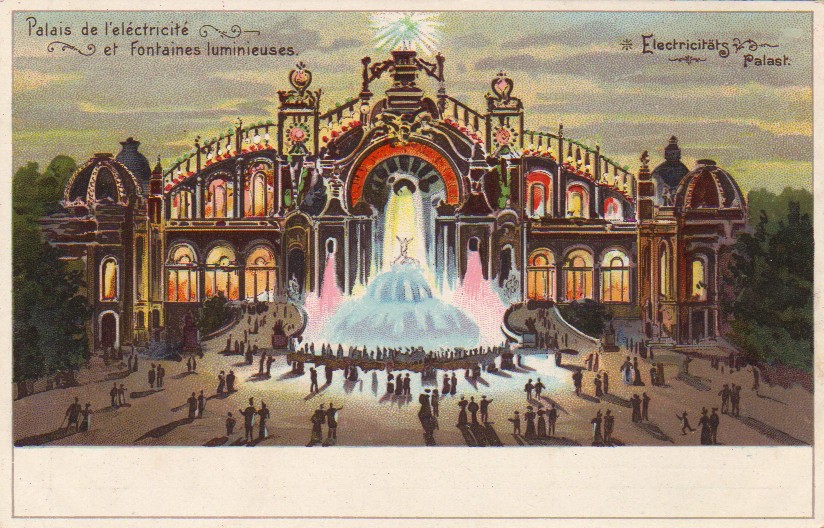
By then, Westinghouse had given up on the Nernst bulb anyway, and had fallen in line with everyone else moving toward vacuum-sealed tungsten-filament lighting anyway. Nernst's magic lamp, which had been used for everything from microscopes to early fax machines to dazzling crowds at the Paris Exposition of 1900, was all but forgotten, except for a few lab-coated monks of research who continued to invoke the term "Nernst Glower" to describe other applications of the glowing-ceramic-rod concept.

Monday, May 2, 2011

Cairo, Illinois


The Victorian author Anthony Trollope, writing in his non-fiction travelogue North America, 1863, devoted a chapter to his ill-fated visit to Cairo, Illinois.

Trollope did not have a good time in Cairo, and he didn't have much nice to say about the population: "Fever and ague universally prevail. Men and women grow up with their lantern faces like spectres. The children are prematurely old; and the Earth, which is so fruitful, is hideous in its fertility... No faces looked out at the windows of the houses, no forms stood in the doorways. A few shops were open, but only in the drinking-shops did I see customers. In these, silent muddy men were sitting, not with drink before them, as men sit with us, but with the cud within their jaws, ruminating. Their drinking is always done on foot. They stand silent at a bar, with two small glasses before them. Out of one they swallow the whisky, and from the other they take a gulp of water, as though to rinse their mouths. After that, they again sit down and ruminate."


Curiously, he notes that the area called Cairo lay in a broader general area popularly known as "Egypt". What was the purpose for the Egyptian motif in the region's nomenclature? No one seems to know now, nor did they then. As Trollope notes: "Who were the founders of Cairo I have never ascertained. They are probably buried fathoms deep in the mud, and their names will no doubt remain a mystery to the latest ages."

The truth is somewhat less flowery. Cairo was founded in 1818 by a fellow named John G. Comegys of Baltimore, Maryland, but it wasn't until 1837 that it really amounted to anything, under the leadership of a Bostonian named Darius B. Holbrook. Prior to Mssrs. Holbrook and Comegys, the area had a few false starts. Lewis & Clark had explored it in November, 1803. Before that, a Frenchman named Charles Juchereau de St. Denys had operated a tannery here in 1702 but soon his enterprise was wiped out by Cherokee. And before that, a French Catholic Priest named Father Louis Hennepin camped here in the Spring of 1660. Seems like only yesterday.

Sunday, May 1, 2011

Incandescence


Hear me well, the gauntlet is now laid down: if you're using CFL bulbs in your home, I won't be coming over for tea anymore.

No, I'm not excessively paranoid about the toxic mercury that resides inside said bulbs, although that certainly is an important consideration for the sake of the environment. Then again, the recent disastrous release of highly radioactive material from Fukushima has rendered that point a bit moot at this time. (Most citizens are apparently too dense to even wrap their head around the implications of that, let alone CFL-mercury in landfills.)

It's a matter of mythic resonance, of aesthetic principles. As devotees of the innovations developed during mankind's true golden age, we must fight the future - especially when evil men are trying so hard to make these annoying CFL bulbs part of that future. Ask yourself why it is so important to President Obama and others to phase out the incandescent bulb. Of all the battles worth fighting, why pick this one?

And yet people are laughing at Rand Paul for opposing the ban (and yes, it does amount to what is practically a ban). God forbid I should be on the same side as Rand Paul on something, but his particular Aspergian adamance for his cause serves us well on this one. At least give the public a choice about how they light their home, rather than strong-arming the world into acceptance of a toxic and inferior light source that no one really wants (that is, except morons. I apologize if you are a moron, dear reader - I do have acquaintances that are - and I pray for you to regain your senses and sensibilities in the coming radioactive days ahead.)

Of course, as far as we're concerned, the incandescent light bulb (which, media to the contrary, was NOT invented by Thomas Edison!) is actually a lightsource-come-lately to the big picture. What about gaslight? What about oil lamps? What about candles? Hell, what about just going to bed when it gets dark, like real people used to do in agrarian times?

The battle against creeping technocracy starts with yourself. I will no longer tolerate CFL or other fluorescent lighting any more than I can get away with avoiding. It's enough that I must tolerate it when shopping in excessively-lit stores like Target, but if you've made your choice and sided with the enemy in your own home, I will not darken your doorstep, good sirs and madams.

You're welcome to come over to my plantation, however, to remember what it looked like to live amongst incandescence before the migraine-inducing, false-color-giving and toxic-for-pets advent of the new world order's CFL bulb.

Make it quick, though: I'm about to start an investigatory pilot project to assess returning completely to oil lanterns and candlepower in my home, in solidarity with our allies in the Dark Sky Movement. Seriously.

Saturday, April 30, 2011

Dark Skies


All Transylvania Gentlemen (and ladies) are urged to join us in supporting The International Dark-Sky Association, a noble unit devoted to decreasing human-generated electic light pollution at night. As their website puts it:

Once a source of wonder--and one half of the entire planet’s natural environment—the star-filled nights of just a few years ago are vanishing in a yellow haze. Human-produced light pollution not only mars our view of the stars; poor lighting threatens astronomy, disrupts ecosystems, affects human circadian rhythms, and wastes energy to the tune of $2.2 billion per year in the U.S. alone.


But most importantly, perhaps, our interest in their efforts are twofold:

For one, we prefer a night sky uncluttered by electric lighting because, simply, that's the way things used to be and is therefore better.

And secondly, because light pollution clouds out the details of the night sky and tends to make it easy to forget that we're actually standing on a tiny rock hurtling through outer space on the edge of a giant galaxy that itself is speeding at unfathomable speeds through an infinite Universe. We don't want people to forget that - we want them to be more cognizant of it than ever.

Friday, April 29, 2011

The Scent Box


Scent boxes, also known as vinaigrettes, were tiny boxes made of silver or sometimes wood, in which a tiny perfume or oil-scented sponge lay in repose under a hinged grill or screen. They were universally used by men and women alike in the 19th century and earlier, this being before the advent of the atomizer spray bottle (invented in 1887 for medical purposes but not popularized for perfume and cologne until after the turn of the century.)

Then, as now, a gentlemen needed a lot of pockets to hold all his stuff. In addition to a scent box, you would also have your snuff box, your silver cigarette case, your silver cigar tube, a spare stickpin for your cravat, several cloth monogrammed handkerchiefs, keys, a pocket watch, a small flask of brandy or bourbon, boxed vestas (matches), Maybe a deck of cards, some hand-carved bone dice, and a condom made of cloth linen or animal bladder.

I'd love to bring the concept of the scent box back, but I frankly already have way too much stuff to lug around in my coat pockets as it is.

Wednesday, April 27, 2011

Known and Not-Known


There once was a time I regarded Donald Rumsfeld as one of the most evil men on Earth.

After all, at a glance, it seems a no-brainer, right? He was a key player in the Nixon, Ford and Bush II administrations. In the Watergate tapes, Nixon praises "Rummy" for his ruthlessness. His complicity in the "weapons of mass destruction" lie, and in the Gitmo atrocities - including continued defense of them even after the human rights violations were made public - would surely drive any sane person to condemn him. Right? And the mission statement and member list of his Project for the New American Century read like a virtual instruction manual and Who's Who for fascism, right?

And yet... and yet. Rage against the machine though we rebels may, let us never lose sight of the fact that Rumsfeld and his ilk do indeed have access to classified information that we do not, and that we cannot truly know why these sort of people do the things they do without knowing what they know. Without apologizing for the atrocities committed under Rumsfeld's watch, at least let us entertain the remote possibility that he knows something that, if we knew it too, would change everything. But like imagining what the fourth dimension is like, we can't even begin to speculate on things that we don't even know that we don't know about.

One of the best indicators to me that old Rummy is less of an Illuminati-esque power-broker and more like a subservient victim trapped like a cog in the gears of a greater beast, is his statement made on public television on February 12, 2002, in which he actually attempted to educate the masses on that very mindset I just spoke of. One might even call it a cry for help via a very telling shibboleth. What he said was:

"There are known knowns; there are things we know we know.

We also know there are known unknowns; that is to say we know there are some things we do not know.

But there are also unknown unknowns – the ones we don't know we don't know."

This is one of the most algebraically elegant, illuminating, and jaw-droppingly truthful things I've ever heard come out of a politician's mouth, and here it is coming from a conservative Republican generally regarded as a shill for the military and mega-corporations.

Most people, however, couldn't even make sense out of Rumsfeld's statement, and immediately his comments became the butt of jokes around the water cooler and among the media talking heads, who said he was talking gobbledygook. That's about the beginning of when I really started feeling like I was living in John Carpenter's They Live and I'm the guy with the special sunglasses. Or at the very least, glad I don't consume the dumbing-down artificial sweeteners that keep people from seeing the Fnords.

Am I ready to join the Donald Rumsfeld fan club? No, far from it. I doubt he and I could ever see eye to eye on much of anything, though the more I learn about him, the less I thought I knew. And I have great difficulty convincing myself that any man is truly evil incarnate - they may do horrible and wicked things due to some sort of mental aberration, or because they were acting on bad information. Old Rummy was, it must be said, a fighter for civil rights in the 60s and 70s, which sets him squarely in a different league than the gray-faced old racists in the Nixon administration that he ended up servile to. The man was an Eagle Scout - which is an organization I hold in high esteem - and he was close personal friends with, of all people, Sammy Davis, Jr., hardly the kind of chum you'd expect from a man reputed to be slightly to the right of Attila the Hun.

Even more eye-opening, there is a possibility that Rummy was actually making a sort of reference to a similar statement made in the 14th century by the Islamic mystic poet Ibn Yamin Faryumadi:


آنکس که بداند و بداند که بداند

اسب خرد از گنبد گردون بجهاند


آنکس که بداند و نداند که بداند

بیدار کنیدش که بسی خفته نماند


آنکس که نداند و بداند که نداند

لنگان خرک خویش به منزل برساند


آنکس که نداند و نداند که نداند

در جهل مرکب ابدالدهر بماند

Translation:


One who knows and knows that he knows: This is a man of knowledge; get to know him!

One who knows, but doesn't know that he knows: This is a man who's unaware, so bring it to his attention.

One who doesn't know, but knows that he doesn't know: This is an illiterate man; teach him!

One who doesn't know and doesn't know that he doesn't know: This is a dumb man; and would be dumb forever!

I also find it worth mentioning that Rummy's autobiography, Known and Unknown: A Memoir, depicts him standing in Taos, New Mexico with the Plaza Blanca mountains behind him. This general area is a paranormal/conspiracy nut's wet dream, what with the Taos Hum, the Taos Vortex, the nearby UFO crashes, the spooky volcanic Ice Caves, and the haunted Taos Inn.

Friday, April 22, 2011

JFK Demanded UFO Files Just Before Death


Not long after the announcement of a memo to J. Edgar Hoover about a crashed UFO, now comes information about two memos from President Kennedy - instructing the CIA to turn over all available UFO intelligence.

Kennedy never saw that data, however. He was assassinated just ten days later.


What does it all mean? The Daily Mail suggests that JFK was worried that the Soviets would mistake actual alien UFOs for U.S. spy craft. majesticdocuments.com suggests that the word "Unknowns" in JFK's memo is actually code for the aliens, and that the phrase "defensive responsibilities" refers to our need to defend ourselves from aliens, not the Russians. They also host scans of the "Burned Memo" which, although lacking the provenance of the other JFK UFO docs, does seem to add corroboration - in it, the CIA director notes that "Lancer" (code word for the President) "has made some inquiries regarding our activities, which we cannot allow."

The burned memo also alludes to Project MAJESTIC, Project JEHOVAH, Project EVIRO, Project PARASITE, and Project PARHELION.

Thursday, April 21, 2011

Pluto's Anomalous Atmosphere


The planet Pluto has always been something of an anomaly. Scientists can't even stop bickering over whether it's even really a planet or not (take our word for it, it most certainly is.)

Many scientists insist that Pluto and its largest moon Charon, should be considered a binary system because the barycentre of their orbits does not lie within either body. Those confused bureaucrats at the IAU haven't been able to come up with an "official" definition for binary dwarf planets (Meanwhile, the rest of the solar system is doing just fine without the IAU's arbitrary proclamations).

Having been declassified from planet status, Pluto is now considered part of the Kuiper belt. But it's unusual among Kuiper Belt objects in that it has an atmosphere. In 1988 it was discovered that Pluto, presumed to be a tiny clod of rock and ice, possessed a very thin methane atmosphere that extended no more than 85 miles above the planet's surface.

The existence of this atmosphere is, in itself, anomalous, but it gets weirder: researchers are now stunned to find it's growing by leaps and bounds. According to sott.net, the atmosphere has been steadily expanding and currently extends for about 1865 miles. Scientists had assumed Pluto's atmosphere would actually shrink as its orbit takes its further away from the sun's warmth, but the opposite is happening. No one's sure why.

Not only that, the chemical composition of it is spontaneously changing: carbon monoxide is now showing up there where it never had before. Again, no one's sure why.

As sott.net wisely opines:

Mainstream astrophysicists are continually "surprised" by new data sent back by space probes and orbiting telescopes. That ought to be a clue that something is wrong. New information always sends theoretical astrophysicists "back to the drawing board". In light of this, it is curious that they have such "cock-sure" attitudes about the infallibility of their present models. Those models seem to require major "patching up" every time a new space probe sends back data.

Monday, April 11, 2011

FBI Releases Declassified Alien Memo


Hold on to your hats, because this is the biggest major step towards full disclosure that the U.S. Government has made yet: the FBI have released a 1950 memo regarding flying saucers crashed in New Mexico that yielded three humanoid corpses.

No, really.

"An investigator for the Air Forces stated that three so-called flying saucers had been recovered in New Mexico. They were described as being circular in shape with raised centers, approximately 50 feet in diameter. Each one was occupied by three bodies of human shape but only 3 feet tall, dressed in metallic cloth of very fine texture. Each body was bandaged in a manner similar to the blackout suits used by speed flyers and test pilots.

According to Mr. [name censored] informant, the saucers were found in New Mexico due to the fact that the Government has a very high-powered radar set-up in that area and it is believed the radar interferes with the controlling mechanism of the saucers."

Ironically, the memo was declassified years ago, and could have already blown up a media frenzy if people had known where to look. With the FBI's new "Vault" site releasing more and more documents to the internet, there will probably be more revelations about all manner of things for which it is the appointed time.

As Javier Ortega is commenting today, " Although this is three years after the reported Roswell incident, the fact that such a cable exists in the hands of the FBI should raise some alarms in your head. If these things are just weather balloons, then why do these cables talk about disc-shaped objects and 3 foot tall beings? More importantly is this last cable. It was directed towards J. Edgar Hoover."

Let's just be real quiet for a few minutes.

Sunday, April 10, 2011

A Method of Reaching Extreme Altitudes


Germany tends to get the credit for mankind's first ventures into space, having sent the first V-2 rocket above the Earth. But long before that, the theoretical groundwork was already trailblazed by American researcher Robert H. Goddard, who began studying rocketry in 1898, inspired by the writings of H.G. Wells. By 1919 he was ready to publicize his findings, and wrote a progress report for the Smithsonian Institution entitled A Method of Reaching Extreme Altitudes. Goddard was the first to suggest that it would be possible to create a liquid-fueled rocket of sufficient power to reach the moon. He soon became a laughing stock in the newspapers for his suggestions. Many educated men in academia and science understood that Goddard was on to something, but the average Joe Q. Public just couldn't be made to grasp the idea (How little times have changed.)


By 1929 he was past theory and actually building prototypes. As an article in the July 18, 1929 edition of Missouri's St. Joseph Gazette explains, citizens and law enforcement agents were shocked to see one of Goddard's experimental creations hurtling through the air. Having no frame for reference for such a thing, most assumed that what they were seeing must have been an airplane of some sort (How little times have changed.)


Curiously, Goddard made Roswell, New Mexico his base of operations in 1930, on a remote property called the Mescalero Ranch. The U.S. Army wasn't very interested in his research despite his repeated attempts to get their attention. However, he had the attention of the Germans and Soviets - spies from both nations were trying to learn all they could about his plans. After World War II, Goddard examined remains of a German V-2 and was certain they had built it by stealing his work. Goddard suddenly came down with throat cancer in 1945, and died just a few months later. The U.S. space agencies posthumously gave the accolades he should've receieved during his lifetime (How little times have changed.)